
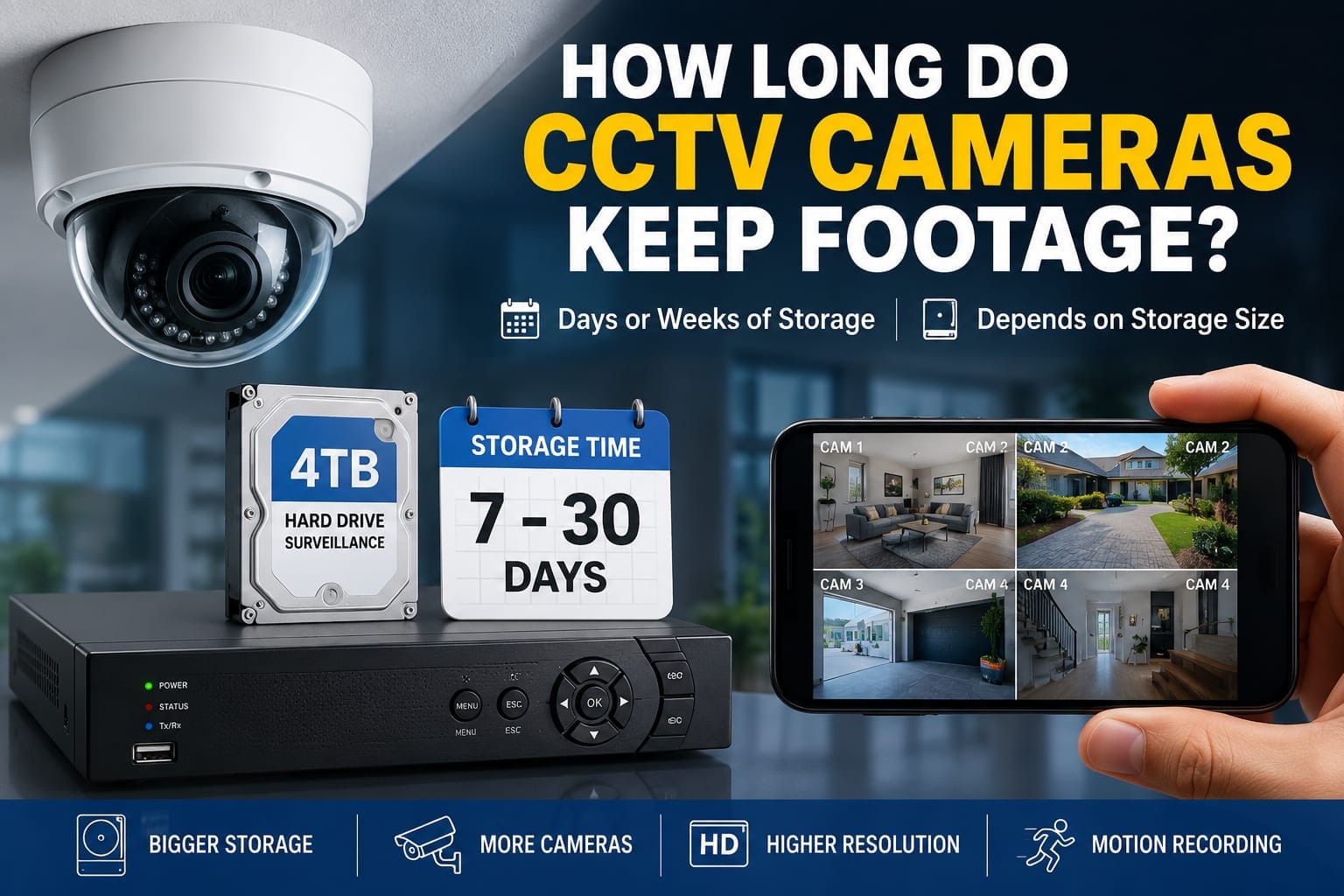

How Long Do CCTV Cameras Keep Footage? (2026 Guide)
How Long Does CCTV Footage Last?
How long does CCTV footage last? Most CCTV systems keep recorded footage for anywhere from several days to several weeks, depending on the system and storage capacity.
If you are wondering how long does CCTV footage last, the answer mainly depends on your storage capacity, camera resolution and recording settings.
The exact recording time depends on factors such as hard drive size, number of cameras, camera resolution, recording quality and whether the cameras record continuously or only when motion is detected.
In this guide, we explain how long CCTV cameras keep footage, what affects CCTV storage time and how to choose the right storage capacity for your home or business.
How Long Is CCTV Footage Usually Stored?
Most CCTV systems store footage for approximately 7 to 30 days, although the actual recording period can be shorter or longer depending on the system configuration.
A CCTV system with a larger surveillance hard drive will normally retain recordings for longer. However, increasing the number of cameras or using higher-resolution cameras can increase the amount of storage required.
When the storage becomes full, most modern NVR and DVR systems automatically overwrite the oldest recordings with new footage. This allows the security system to continue recording without requiring users to manually delete old recordings.
What Affects CCTV Storage Time?
Several factors determine how long CCTV cameras keep footage.
The most important factors include:
Hard drive storage capacity
Number of CCTV cameras
Camera resolution
Video compression technology
Recording quality
Frame rate
Continuous or motion recording
Hours of recording each day
Understanding these factors can help you select the right storage capacity for your security system.
Hard Drive Storage Capacity
Hard drive capacity is one of the biggest factors affecting CCTV recording time.
Security systems commonly use surveillance hard drives with capacities such as 1TB, 2TB, 4TB or larger.
A larger hard drive can generally store more footage before older recordings are overwritten. However, storage requirements should always be calculated based on the complete CCTV system rather than hard drive size alone.
For example, a 4TB hard drive connected to four cameras may retain footage considerably longer than the same drive connected to eight cameras with similar recording settings.
Number of CCTV Cameras
The number of cameras connected to the NVR or DVR directly affects storage usage.
Every additional camera creates additional video data that must be stored on the hard drive.
A four-camera CCTV system will therefore generally keep recordings for longer than an eight-camera system using the same hard drive capacity and similar camera settings.
Businesses with many cameras may require larger hard drives or multiple storage drives to achieve their desired recording period.
Does Camera Resolution Affect Storage?
Yes. Higher-resolution cameras normally require more storage space.
For example, higher-resolution CCTV cameras produce more video data than lower-resolution cameras when other recording settings are similar.
Modern high-resolution cameras provide better image detail, which can be valuable when identifying people, vehicles or other important events. However, the improved image quality needs to be considered when calculating storage requirements.
Choosing the highest possible resolution without considering storage is not always the best approach. The complete system should be configured to balance image quality, recording time and storage capacity.
Continuous Recording vs Motion Recording
How your cameras are configured to record can significantly affect how long footage is retained.
Continuous recording means the camera records throughout the configured recording period, whether movement is detected or not. This provides consistent coverage but uses more storage.
Motion recording records when movement or another configured event is detected. Because less video may be recorded, this can reduce storage usage and potentially increase the amount of time recordings remain available.
Some modern CCTV systems also support intelligent event recording, such as human or vehicle detection.
The best recording method depends on the property and security requirements.
When considering how long do CCTV cameras keep footage, the recording method can make a significant difference to storage time.
What Happens When CCTV Storage Is Full?
In most modern CCTV systems, recording does not simply stop when the hard drive becomes full.
Instead, the NVR or DVR normally begins overwriting the oldest footage with new recordings.
For example, if your system retains approximately 20 days of footage, recordings from the oldest day may gradually be replaced as new footage is recorded.
This makes it important to export and save important footage as soon as possible after an incident.
If you need a particular recording for an insurance claim, security incident or other purpose, it should be backed up before the system overwrites it.
Can CCTV Footage Be Saved Permanently?
Yes. Important CCTV footage can usually be exported from the recorder and stored separately.
Depending on the CCTV system, recordings may be exported to:
USB storage devices
Computers
External storage
Network storage
Supported cloud services
Once the required footage has been exported and saved separately, it will not be affected when the NVR or DVR overwrites older recordings.
How Much CCTV Storage Do I Need?
There is no single storage size that is suitable for every CCTV system.
The right storage capacity depends on:
How many cameras you have
Camera resolution
Recording quality
Frame rate
Recording schedule
Motion or continuous recording
How many days of footage you want to retain
A small residential CCTV system may have very different storage requirements from a commercial property with multiple high-resolution cameras.
Before selecting a hard drive, it is better to calculate the expected storage requirement for the complete system.
How long CCTV footage lasts depends heavily on storage capacity, the number of cameras, camera resolution and recording settings.
For additional CCTV security and installation advice, visit the Victoria Police CCTV installation guide.
How Can You Keep CCTV Footage for Longer?
If you need a longer recording history, several options may help.
You can:
Install a larger surveillance hard drive
Add additional storage where supported
Use efficient video compression
Adjust recording quality where appropriate
Reduce unnecessary recording
Use motion or intelligent event recording where suitable
Configure an appropriate recording schedule
However, reducing video quality simply to gain additional storage is not always a good decision. Security footage needs to remain clear enough to be useful when an incident occurs.
Why Choose Techno Trading?
Choosing the right CCTV system involves more than selecting cameras.
At Techno Trading, we provide CCTV solutions for homes and businesses across Melbourne. We can help determine the appropriate cameras, recorder and storage capacity based on the property and required recording period.
A properly designed CCTV system provides a better balance between image quality, storage capacity and recording time.
Learn more about our Professional CCTV Installation Services or Contact Us for advice about choosing a CCTV system for your property.
Conclusion
So, how long do CCTV cameras keep footage?
Many CCTV systems retain recordings for approximately 7 to 30 days, but there is no universal storage period. The actual recording time depends on hard drive capacity, number of cameras, resolution, compression and recording settings.
If keeping footage for a specific number of days is important, the storage capacity should be calculated before the CCTV system is configured.
Selecting the right storage from the beginning helps ensure that important recordings are still available when you need them.
FAQ
How long do CCTV cameras keep footage?
Many CCTV systems keep footage for approximately 7 to 30 days, although the actual period depends on storage capacity, number of cameras, resolution and recording settings.
Does CCTV footage automatically delete?
Most modern NVR and DVR systems automatically overwrite the oldest footage when their storage becomes full.
Can CCTV footage be kept for more than 30 days?
Yes. A CCTV system can potentially retain footage for longer by using sufficient storage capacity and appropriate recording settings.
Does higher camera resolution use more storage?
Generally, yes. Higher-resolution video contains more data and can require more storage, although compression technology and other recording settings also affect storage usage.
Is motion recording better for CCTV storage?
Motion or event-based recording can reduce the amount of video stored compared with continuous recording, potentially allowing footage to remain available for longer.
What happens if I need to keep important CCTV footage?
Export the required recording from the NVR or DVR and save it separately before the system overwrites the footage.