
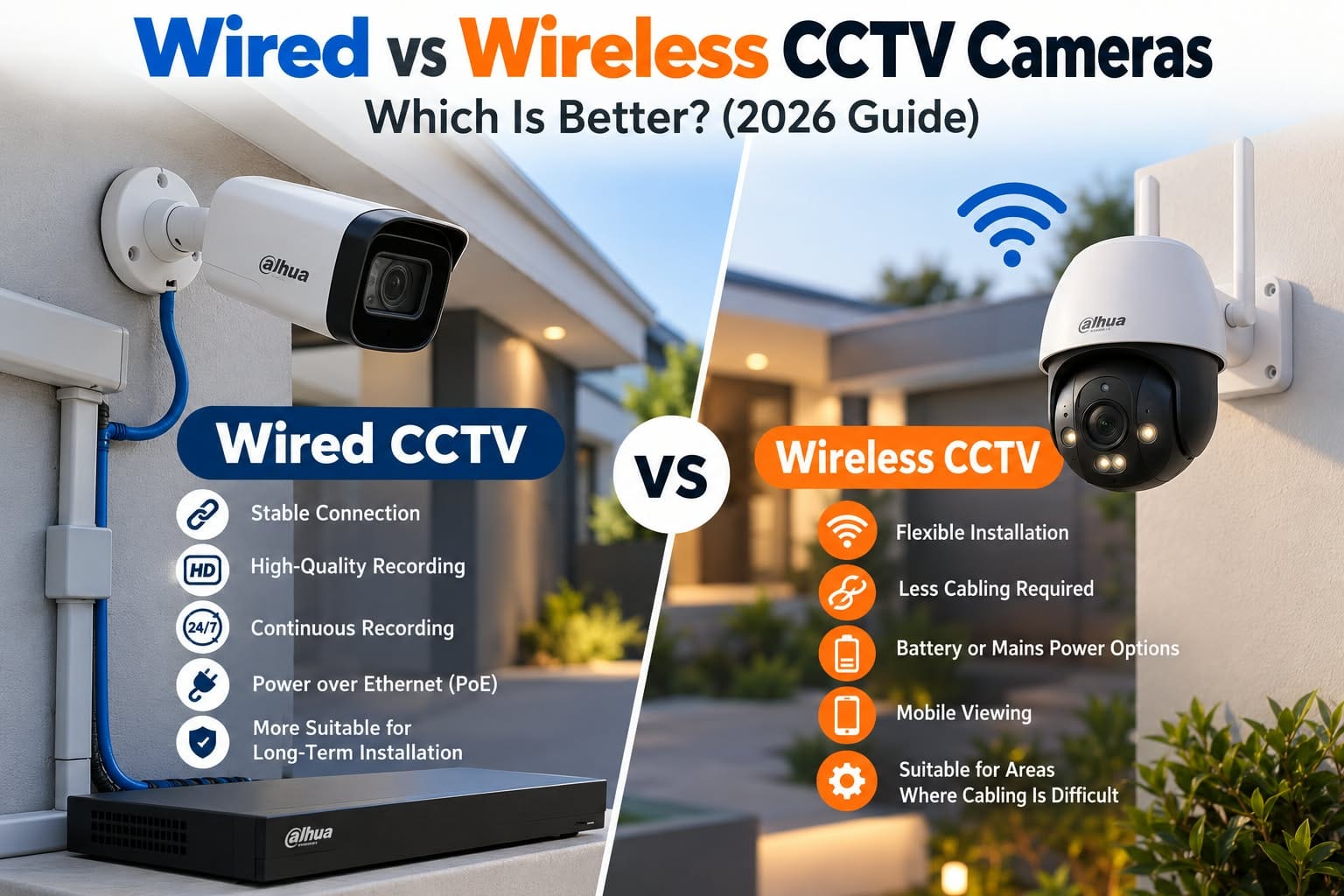
Wired vs Wireless CCTV Cameras: Which Is Better? (2026 Guide)
Choosing the right CCTV system is an important decision for homeowners and businesses.
One of the most common questions is whether wired or wireless security cameras are better.
Both options can provide useful security monitoring, but they work differently and have different requirements for connectivity, power, recording and installation.
Wired vs wireless CCTV cameras is not simply a comparison between old and new technology. Modern wired IP cameras can provide advanced features such as high-resolution recording, smart detection, mobile viewing and active deterrence.
Wireless cameras can also provide many useful features, particularly when running network cables is difficult.
This guide explains the differences between wired and wireless CCTV cameras, their advantages and limitations, and how to choose the most suitable option for your property.
What Are Wired CCTV Cameras?
Wired CCTV cameras use a physical cable connection to transmit video or network data.
Traditional analogue CCTV cameras commonly use coaxial cabling connected to a Digital Video Recorder, known as a DVR.
Modern wired IP cameras usually connect through Ethernet cabling to a network switch or Network Video Recorder, known as an NVR.
Many professional IP camera systems use Power over Ethernet, or PoE.
With compatible equipment, PoE allows power and network data to travel through a single Ethernet cable.
This can provide a practical and stable connection for permanently installed security cameras.
Wired cameras are commonly used in homes, offices, shops, warehouses and other properties where reliable continuous monitoring is important.
What Are Wireless CCTV Cameras?
Wireless CCTV cameras generally use Wi-Fi or another wireless communication method to transmit video or connect to a network.
However, wireless does not always mean completely cable-free.
Many Wi-Fi cameras still require a power cable connected to an electrical outlet or suitable power supply.
Other models operate using rechargeable batteries or solar-assisted charging.
Wireless CCTV cameras may store recordings on a memory card, compatible recorder or cloud service, depending on the equipment.
Some wireless cameras support continuous recording, while others are designed mainly for motion-triggered events.
Understanding these differences is important before choosing a wireless camera system.
Wired vs Wireless CCTV Cameras: Main Differences
The main differences between wired and wireless CCTV cameras involve connectivity, power, recording, installation and long-term reliability.
Wired cameras use physical network or video cabling, while wireless cameras communicate through a wireless network.
A wired connection can reduce dependence on Wi-Fi coverage and wireless interference.
Wireless cameras can offer more flexibility when installing network cabling would be difficult.
However, wireless systems still depend on suitable power arrangements, network coverage and compatible recording equipment.
Neither option is automatically better for every property.
The right choice depends on how the cameras will be used.
Connection Reliability
Connection reliability is one of the most important factors when comparing wired vs wireless CCTV cameras.
Wired cameras use physical connections between the camera and the recording or networking equipment.
A properly installed wired system can provide consistent communication without relying on the strength of a Wi-Fi signal.
Wireless cameras depend on radio communication.
Wi-Fi performance can be affected by several factors, including:
• Distance from the router
• Thick walls
• Building materials
• Network congestion
• Interference
• Router placement
• Other connected devices
In a property with weak Wi-Fi coverage, wireless cameras may experience connection problems.
A wired CCTV system may be more suitable when reliable continuous recording is a priority.
Video Quality
When comparing wired vs wireless CCTV cameras, both options can provide high-resolution images.
Camera resolution, sensor quality, lens selection, lighting and video compression all affect image quality.
A wireless camera is not necessarily lower quality simply because it uses Wi-Fi.
However, wireless network performance can affect how consistently video is transmitted.
Some systems may reduce video quality or experience interruptions when network conditions are poor.
Wired IP cameras can provide a dedicated physical network connection that is less affected by wireless congestion.
For properties requiring several high-resolution cameras recording continuously, wired connectivity can be particularly useful.
Continuous Recording vs Motion Recording
Recording capability is another important difference when comparing wired vs wireless CCTV cameras.
Many wired CCTV systems use an NVR or DVR to record footage continuously.
Depending on the equipment, users may also configure scheduled or event-based recording.
Wireless cameras can use different recording methods.
Some support continuous recording to compatible local storage or recording equipment.
Others primarily record short clips when motion or another event is detected.
Battery-powered cameras often use event-based recording to conserve energy.
Before choosing a system, consider whether you need:
• Continuous 24/7 recording
• Motion-triggered recording
• Smart event recording
• Local storage
• Remote playback
• Long-term recording retention
The recording method should match your security requirements.
Power Supply Requirements
Power requirements are often misunderstood when comparing wired vs wireless CCTV cameras.
Wired PoE cameras can receive power and data through a compatible Ethernet connection.
This means a separate power cable at each camera location may not be necessary.
Many wireless Wi-Fi cameras still require a nearby electrical power source.
Battery-powered cameras can operate without a permanent power cable, but their batteries need recharging or replacement.
Solar-assisted cameras may reduce manual charging requirements, although performance depends on sunlight, energy consumption and equipment design.
A battery camera is not automatically suitable for continuous recording.
Power requirements should be checked before installation.
CCTV Installation Requirements
Installation requirements for wired vs wireless CCTV cameras vary depending on the property, camera type and available infrastructure.
Wired CCTV installations usually require suitable cable routes between the cameras and recording or network equipment.
This may involve roof spaces, wall cavities, conduits or other appropriate pathways.
Wireless cameras can reduce the need for network cabling.
However, they still require suitable mounting locations, Wi-Fi coverage and power arrangements.
A wireless camera installed far from the router may not perform reliably.
A wired camera installed without proper cabling or suitable weather protection may also experience problems.
Professional planning is important for both types of CCTV systems.
Wired CCTV for Single-Storey Homes
Single-storey homes can often provide accessible cable routes through roof spaces.
This may make wired CCTV installation practical for many residential properties.
However, roof design, insulation, extensions and existing construction can affect cable access.
Camera locations should be planned according to the areas requiring monitoring.
A suitable installation may include cameras covering entrances, driveways, garages, side access and backyards.
The final layout depends on the property rather than the number of cameras in a package.
Wired CCTV for Double-Storey Homes
Double-storey homes can require additional cabling planning.
Running cables between floors or to certain exterior walls may be more complicated than in a typical single-storey property.
This does not mean wired CCTV cannot be installed.
The installation method depends on the building structure, available cable pathways and camera locations.
Wireless cameras may be considered in areas where network cabling is impractical.
However, Wi-Fi coverage and electrical power still need to be considered.
Wireless CCTV for Existing Homes
Wireless CCTV cameras may be useful for existing homes where running network cables is difficult.
They can also be suitable for certain secondary monitoring areas.
For example, a homeowner may want to monitor an additional entrance or area without extending the existing wired CCTV network.
However, a wireless system should not be selected only because installation appears easier.
The camera still needs a reliable connection, suitable power and appropriate weather protection.
The intended recording method should also be considered.
Night Vision Performance
Both wired and wireless cameras can provide night vision.
Many cameras use infrared illumination to capture footage in low-light conditions.
Other models can provide full-colour night imaging using available or supplementary light.
Night performance depends mainly on the camera technology and environment rather than whether the camera is wired or wireless.
Important factors include:
• Camera sensor
• Lens
• Lighting
• Infrared range
• Viewing distance
• Mounting position
• Weather conditions
Camera placement and night-time lighting should be considered before selecting equipment.
Smart Detection Features
Modern wired and wireless CCTV cameras may support smart detection.
Depending on the model, available features can include:
• Human detection
• Vehicle detection
• Motion detection
• Intrusion zones
• Line crossing
• Smart notifications
• Active deterrence
These features depend on the camera, recorder and software.
A wired camera is not automatically smarter than a wireless camera.
However, some professional wired IP camera systems provide advanced analytics and integration with compatible NVR equipment.
Smart detection should be selected according to the events you actually want to monitor.
Mobile Viewing
Many modern CCTV systems allow users to view cameras through a smartphone application.
Depending on the equipment, mobile features may include:
• Live viewing
• Recording playback
• Event notifications
• Camera switching
• Video downloads
• Two-way audio
Both wired and wireless CCTV systems may support remote mobile access.
Remote viewing generally requires a suitable internet connection.
The available features depend on the camera, recorder and mobile application.
Does Wired CCTV Work Without Internet?
Many wired CCTV systems can continue recording locally without an active internet connection.
For example, compatible IP cameras can communicate with an NVR over the local network.
If the internet connection becomes unavailable, the NVR may continue recording footage from locally connected cameras.
However, remote mobile viewing and certain online notifications may stop working until the internet connection returns.
This is an important distinction between local CCTV recording and internet-based services.
Does Wireless CCTV Work Without Internet?
The answer depends on the wireless camera system.
Some Wi-Fi cameras can continue recording to local storage or compatible equipment when internet access is unavailable, provided the required local network and power remain operational.
Other cameras depend more heavily on cloud connectivity.
If the internet connection fails, cloud recording, remote access or notifications may become unavailable.
Some systems may also have limitations on local playback or operation.
Always check the specific camera’s offline recording capabilities before purchasing.
Local Storage vs Cloud Storage
CCTV footage can be stored in different ways.
Many wired systems use an NVR or DVR with an installed surveillance hard drive.
Some wireless cameras use microSD cards or compatible local recording devices.
Other systems offer cloud storage.
Cloud services may involve subscription fees and depend on internet connectivity.
Local recording can provide more control over footage storage and may operate without an ongoing cloud subscription.
However, local storage equipment should be protected from theft, damage and unauthorised access.
The appropriate storage method depends on recording requirements and the selected equipment.
How Long Can CCTV Cameras Record?
Recording duration depends on several factors.
These include:
• Number of cameras
• Resolution
• Frame rate
• Video compression
• Continuous or event recording
• Storage capacity
• Recording schedule
A system recording continuously from several high-resolution cameras will generally use more storage than a camera saving occasional event clips.
Battery-powered wireless cameras may also have limitations on recording duration because of power consumption.
Storage requirements should be calculated according to the intended use.
CCTV Security and Privacy
Both wired and wireless CCTV systems require appropriate security configuration.
Wireless cameras should use secure Wi-Fi networks and strong account credentials.
Wired cameras should also be protected through appropriate network configuration, access controls and software updates.
Useful security practices include:
• Strong unique passwords
• Multi-factor authentication where supported
• Regular firmware updates
• Secure router settings
• Limiting unnecessary remote access
• Reviewing account permissions
A wired connection does not automatically make a CCTV system completely secure.
Network security and device configuration remain important.
What Happens During a Power Outage?
Most CCTV systems require electrical power to operate.
Wired PoE cameras normally depend on powered network equipment or a compatible NVR.
Wireless cameras with mains power also stop operating if their power source fails.
Battery-powered cameras may continue operating during a power outage, depending on their battery charge and system design.
A suitable uninterruptible power supply, or UPS, may help maintain operation of selected wired CCTV equipment for a limited period.
However, the actual backup duration depends on the power requirements and UPS capacity.
Maintenance Requirements
Wired and wireless CCTV cameras both require maintenance.
Common maintenance tasks include:
• Cleaning camera lenses
• Checking recording status
• Reviewing camera angles
• Checking storage capacity
• Updating firmware
• Testing notifications
• Inspecting exposed cables and connections
Wireless cameras may also require battery charging, battery replacement or Wi-Fi troubleshooting.
A properly installed wired system can reduce the need for regular battery maintenance.
However, all security systems should be checked periodically.
Wired vs Wireless CCTV Cameras for Businesses
Businesses often require reliable recording across several areas.
These may include:
• Entrances
• Customer areas
• Offices
• Stock rooms
• Warehouses
• Loading zones
• Car parks
• External boundaries
For businesses requiring multiple cameras and continuous recording, a wired IP CCTV system can provide practical advantages.
Wireless cameras may still be suitable for particular locations or specialised applications.
The decision should be based on the building layout, recording requirements and network infrastructure.
CCTV for Warehouses and Commercial Properties
Warehouses and commercial buildings can present additional challenges.
Large internal spaces, long distances, metal structures and multiple access points can affect camera installation.
Wireless performance may be influenced by building materials, interference and distance from network equipment.
Wired CCTV networks can provide a more predictable connection when properly designed.
However, long Ethernet cable runs may require additional networking equipment or alternative connection methods.
Professional site planning is particularly important for larger properties.
Which CCTV System Is Better for Home Security?
For many homes where permanent cabling is practical, wired IP CCTV can be a strong option.
A wired system can provide reliable connectivity, local NVR recording and support for multiple cameras.
Wireless CCTV may be suitable where cable installation is difficult or where flexible camera placement is more important.
Battery-powered cameras may also be useful for certain locations where both network cabling and mains power are unavailable.
The best choice depends on the property and how the cameras will be used.
Are Wireless CCTV Cameras Easier to Install?
Wireless cameras can be easier to position because they do not require a physical network connection.
However, installation still involves several considerations.
The camera must be mounted securely and positioned to capture useful footage.
Wi-Fi signal strength should be checked at the installation location.
Power arrangements, weather exposure and recording settings must also be considered.
Wireless does not always mean installation-free.
Are Wired CCTV Cameras More Reliable?
A properly designed wired CCTV system can provide more consistent network communication than a wireless system operating in challenging Wi-Fi conditions.
However, reliability also depends on the quality of equipment, cabling, power supply and configuration.
Damaged cables, unsuitable network equipment or poor installation can affect wired systems.
Likewise, a properly configured wireless camera with strong network coverage may operate reliably.
The important consideration is whether the complete system suits the installation environment.
Cost of Wired vs Wireless CCTV Cameras
The cost of a CCTV system depends on more than whether the cameras are wired or wireless.
Important factors include:
• Camera quantity
• Camera resolution
• Recording equipment
• Storage capacity
• Smart detection features
• Power requirements
• Cabling
• Installation complexity
• Building structure
• Future expansion
Wired systems may involve additional labour for cabling.
Wireless systems may reduce some cabling requirements but can involve other costs, such as batteries, additional Wi-Fi equipment or optional cloud subscriptions.
The total cost should be compared over the expected life of the system rather than only the initial camera price.
Can You Combine Wired and Wireless CCTV Cameras?
In some situations, wired and wireless cameras can be used within the same property.
For example, a home may have a wired NVR system covering the main entrances and a separate wireless camera monitoring another area.
However, cameras from different systems may not automatically work together.
Compatibility, recording methods, applications and network configuration should be checked.
Using both technologies can be practical when each camera has a clear purpose.
What to Consider Before Choosing CCTV Cameras
Before selecting wired or wireless CCTV cameras, consider the following questions:
• Which areas need monitoring?
• Is continuous recording required?
• Are suitable cable routes available?
• Is Wi-Fi coverage reliable?
• Is mains power available?
• Is local recording important?
• Are smart detection features required?
• How many cameras are needed?
• Will the system be expanded later?
• What is the available budget?
Answering these questions can help determine the most practical CCTV system for your property.
Professional CCTV Installation in Melbourne
Techno Trading provides CCTV security solutions for homes and businesses across Melbourne.
We can assist with camera selection, camera positioning, cabling, NVR setup, recording configuration and mobile viewing.
For many permanent installations, wired IP CCTV systems can provide practical advantages in connectivity and recording.
However, the appropriate system should always be selected according to the individual property and monitoring requirements.
Our services also include smart locks, video intercoms, alarm systems, access control and smart home solutions.
Why Choose Techno Trading?
Techno Trading specialises in security systems and smart technology.
We work with residential and commercial properties across Melbourne.
Our CCTV services can include:
• Camera selection
• CCTV system planning
• Professional cabling
• Camera installation
• NVR configuration
• Mobile viewing setup
• Recording configuration
• System testing
We aim to provide practical security solutions based on the needs of each property.
Wired vs Wireless CCTV Cameras: Final Verdict
When comparing wired vs wireless CCTV cameras, neither option is automatically the best choice for every situation.
Wired CCTV systems can be particularly suitable for permanent installations requiring reliable connectivity, continuous recording and multiple cameras.
Wireless cameras can provide flexibility where running network cables is difficult.
However, wireless connectivity, power requirements, storage options and recording limitations should be considered carefully.
For homes and businesses planning a long-term security system, the best approach is to choose equipment based on the actual monitoring requirements.
Contact Techno Trading
If you need help choosing a CCTV system for your home or business in Melbourne, contact Techno Trading.
Phone: (03) 9969 7571
Mobile: 0415 214 452
Email: info@technotrading.com.au
Showroom:
5A/70 Mahoneys Road
Thomastown VIC 3074
Frequently Asked Questions
Are wired CCTV cameras better than wireless cameras?
Wired CCTV cameras can provide more consistent network connectivity and are often suitable for continuous recording. Wireless cameras can be useful where network cabling is difficult. The best option depends on the property and recording requirements.
Do wireless CCTV cameras need power cables?
Many Wi-Fi cameras still require a power cable. Battery-powered models may operate without permanent wiring, but they require charging or another suitable power source.
Can wireless CCTV cameras record 24/7?
Some wireless cameras support continuous recording, but many battery-powered models primarily use motion-triggered recording. Check the specific camera and storage capabilities.
Do wired CCTV cameras need Wi-Fi?
No. Many wired IP CCTV systems communicate through Ethernet cabling and do not require Wi-Fi for local operation.
Can CCTV cameras record without internet?
Many compatible wired systems and some wireless systems can record locally without an active internet connection. The exact functionality depends on the equipment and configuration.
Which is better for a business, wired or wireless CCTV?
Wired CCTV is often suitable for businesses requiring several cameras and continuous recording. Wireless cameras may be useful in selected areas where running cables is impractical.
Are wireless security cameras secure?
Wireless cameras can be secure when properly configured with strong passwords, updated firmware and appropriate Wi-Fi security. Security also depends on the device and manufacturer.
Can I install both wired and wireless CCTV cameras?
Yes, in some situations. However, compatibility and recording arrangements should be checked because different cameras may not integrate into the same system.