
What Is Smart Detection in CCTV Cameras? (2026 Guide)
Modern security cameras can do much more than simply record video.
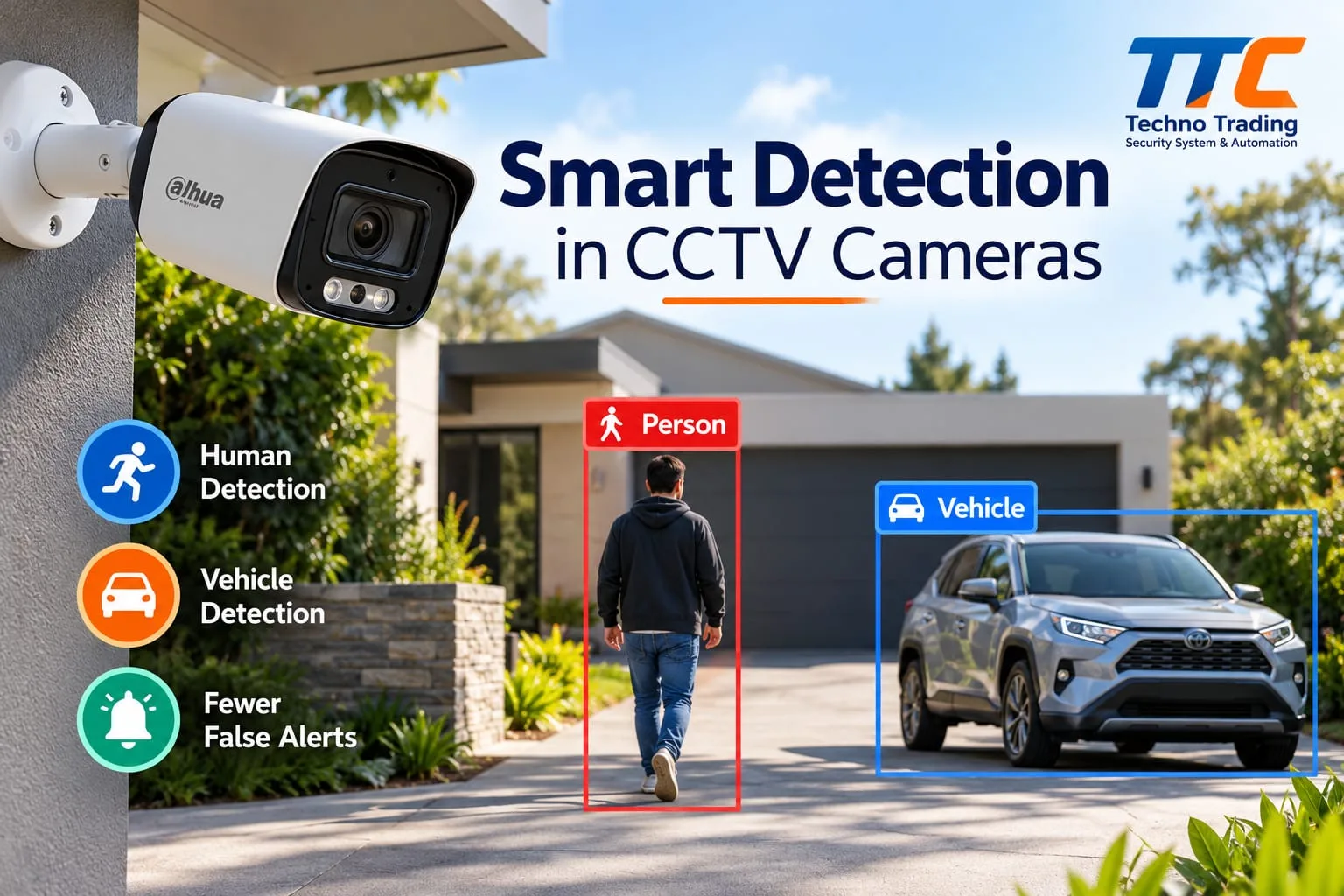
Traditional CCTV systems mainly record footage or detect basic movement. Modern security cameras can use smart detection technology to identify specific types of activity and provide more useful alerts.
For example, instead of sending a notification every time leaves move in the wind, a compatible camera may be able to identify whether the movement was caused by a person or vehicle.
Smart detection in CCTV cameras can make a security system easier to monitor and can help users focus on events that may actually matter.
But how does smart detection work, how is it different from normal motion detection, and which features should you look for when choosing a CCTV system?
This guide explains the most important smart detection features available in modern CCTV cameras.
What Is Smart Detection in CCTV Cameras?
Smart detection in CCTV cameras refers to technology that analyses video and attempts to identify particular types of events, objects or movement.
Instead of treating every change in the image as the same type of motion, compatible cameras or recorders can analyse what is happening within the scene.
Depending on the system, smart detection may include:
• Human detection
• Vehicle detection
• Intrusion detection
• Line crossing detection
• Area detection
• Smart motion detection
• Active deterrence
• Event notifications
The exact features available depend on the camera, recorder and manufacturer.
Not every CCTV camera supports the same detection functions, so equipment should be selected according to the monitoring requirements of the property.
How Does CCTV Smart Detection Work?
A security camera continuously captures images from the area it monitors.
When movement or another configured event occurs, compatible video analytics can analyse the scene and compare the activity against predefined detection rules.
For example, a system configured for human detection may attempt to determine whether an object moving through the scene has characteristics associated with a person.
If the event meets the configured criteria, the system may:
• Mark the event in the recording
• Send a mobile notification
• Trigger recording
• Activate a warning light
• Activate an audible warning
• Perform another compatible action
The available response depends on the equipment and configuration.
Smart Detection vs Motion Detection
Smart detection and traditional motion detection are not the same thing.
generally looks for changes between video frames.
When enough pixels change within the image, the system may interpret that change as movement.
The problem is that many things can create movement.
Examples include:
• Tree branches
• Moving leaves
• Shadows
• Rain
• Insects
• Animals
• Headlights
• Changes in lighting
This can result in unnecessary alerts.
Smart detection attempts to analyse the event further and determine what type of object or activity caused the movement.
This can make notifications more useful when the system is correctly configured.
What Is Human Detection?
Human detection is designed to identify people within a camera’s field of view.
Instead of generating the same alert for every movement, a compatible CCTV system can attempt to recognise movement associated with a person.
This can be particularly useful around:
• Front entrances
• Driveways
• Side access
• Backyards
• Garages
• Business entrances
• Restricted areas
For example, a homeowner may be more interested in receiving an alert when a person enters the driveway than when a tree moves in strong wind.
Human detection can help make this possible.
What Is Vehicle Detection?
Vehicle detection is designed to identify vehicles entering or moving through a monitored area.
Depending on the system and camera position, this can be useful for:
• Driveways
• Car parks
• Business entrances
• Loading areas
• Gates
• Warehouses
• Commercial properties
A CCTV system may allow users to search or filter recordings based on detected vehicle events.
This can make reviewing footage easier compared with manually searching through long periods of continuous video.
Human and Vehicle Classification
Some modern CCTV systems provide both human and vehicle classification.
When an event occurs, the system attempts to determine whether the object is a person, a vehicle or another type of movement.
This can provide more control over notifications.
For example, a user may configure a camera to send alerts for people entering a particular area while ignoring vehicles travelling along a nearby road.
Correct camera positioning and configuration are important for these features to work effectively.
What Is Smart Motion Detection?
Smart motion detection combines traditional movement detection with additional analysis.
Instead of generating alerts for all detected movement, the system can attempt to filter events according to selected object types.
This may help reduce notifications caused by irrelevant movement.
However, smart detection should not be treated as perfect.
Detection accuracy can be affected by:
• Camera angle
• Distance
• Lighting
• Weather
• Object size
• Obstructions
• Camera resolution
• Detection settings
Correct installation and configuration therefore remain important.
What Is Line Crossing Detection?
Line crossing detection allows a virtual line to be created within the camera image.
The system can then monitor whether an object crosses that line.
For example, a virtual line could be placed across:
• A driveway
• A gate
• A side pathway
• A restricted entrance
• A warehouse access point
Depending on the equipment, the system may also allow the detection direction to be configured.
This means an event may be generated only when someone crosses the line in a particular direction.
What Is Intrusion Detection?
Intrusion detection generally allows a specific area within the camera view to be defined.
The system then monitors activity inside that area according to the configured rules.
For example, an intrusion zone could be created around a side entrance or restricted area.
When a person or vehicle enters the selected zone, the system may create an event or send a notification.
This can be more useful than monitoring every movement across the entire camera image.
What Are Detection Zones?
Detection zones allow users to select specific parts of a camera image for monitoring.
This can help prevent unnecessary alerts from areas that are not relevant.
For example, a camera installed at the front of a home may also capture part of a public road.
If the entire image is monitored, passing traffic could create frequent events.
A detection zone may allow the system to focus primarily on the driveway or entrance instead.
Careful configuration can significantly improve the usefulness of CCTV notifications.
Can Smart Detection Reduce False Alerts?
One of the main reasons people use smart detection is to reduce unnecessary notifications.
Traditional motion detection can sometimes generate frequent alerts from environmental movement.
Smart detection can help filter some of these events by identifying people or vehicles.
However, no detection system can guarantee that every event will be classified correctly.
False or missed detections can still occur.
Performance depends on the camera, analytics, installation environment and configuration.
What Causes False CCTV Alerts?
False alerts can have many causes.
Common examples include:
• Moving vegetation
• Strong shadows
• Spider webs
• Insects close to the camera
• Rain
• Reflections
• Vehicle headlights
• Sudden lighting changes
• Animals
• Incorrect sensitivity settings
Camera installation also matters.
A camera positioned too close to moving vegetation, for example, may create unnecessary activity even when smart analytics are enabled.
Good CCTV design should therefore combine suitable equipment with appropriate camera positioning.
What Is Active Deterrence?
Active deterrence cameras are designed not only to record events but also to provide a visible or audible response when selected activity is detected.
Depending on the model, active deterrence features may include:
• Flashing lights
• Warning lights
• Sirens
• Recorded voice warnings
• Two-way audio
For example, a compatible camera may activate a warning light when a person enters a configured area.
The objective is to make the camera’s presence more noticeable and provide an immediate response to selected events.
Smart Detection and Active Deterrence
Smart detection can make active deterrence more useful.
Without appropriate detection rules, a warning light or siren could activate too frequently.
When smart detection is correctly configured, the system can respond to more specific events.
For example, a camera may be configured to activate a warning when a person enters a selected area during certain times.
Available rules and schedules depend on the camera and recording system.
Can CCTV Send Alerts to Your Phone?
Many modern CCTV systems can send event notifications to compatible mobile applications.
Depending on the equipment and configuration, notifications may be generated for:
• Human detection
• Vehicle detection
• Motion
• Intrusion events
• Line crossing
• Other supported smart events
Mobile notifications normally require the CCTV system to have suitable network and internet connectivity.
Local recording and remote notifications are separate functions.
A compatible NVR may continue recording locally even if remote notifications are temporarily unavailable because of an internet outage.
Can You Search CCTV Footage Using Smart Events?
On compatible CCTV systems, smart events can make recorded footage easier to review.
Instead of manually scrolling through many hours of video, users may be able to filter recordings according to event types.
For example, footage could potentially be filtered for:
• Human events
• Vehicle events
• Motion events
• Intrusion events
The exact search functions depend on the camera and NVR.
This can be particularly useful for systems that record continuously.
Does Smart Detection Require an NVR?
It depends on the CCTV system.
Some smart analytics are processed directly by the camera, while other features may depend on a compatible NVR or recorder.
In some systems, both the camera and recorder must support the required feature.
Compatibility is therefore important.
A camera may advertise a particular smart feature, but the complete CCTV system should be checked to make sure the feature can be used as intended.
Does Smart Detection Need Internet?
Many smart detection functions can operate locally without requiring a continuous internet connection.
For example, compatible cameras and NVRs may process detection events and record footage through the local network.
However, internet access is generally required for functions such as remote mobile notifications and viewing the CCTV system while away from the property.
The exact requirements depend on the equipment and system configuration.
Does Smart Detection Work at Night?
Smart detection may operate at night, but performance depends on image quality and the camera’s ability to capture useful detail in low-light conditions.
Cameras may use technologies such as:
• Infrared night vision
• Full-colour night imaging
• Supplementary lighting
Camera placement is also important.
Poor lighting, excessive distance or unsuitable viewing angles can affect detection performance.
Night-time CCTV planning should therefore consider both detection capability and image quality.
Is Smart Detection the Same as Facial Recognition?
No.
Human detection generally attempts to determine whether an object appears to be a person.
Facial recognition is a different and more specialised technology designed to analyse facial characteristics.
A camera that supports human detection does not automatically support facial recognition.
The same distinction applies to vehicle detection and number plate recognition.
These technologies perform different functions and should not be treated as interchangeable.
Smart Detection for Home CCTV
Smart Detection in CCTV Cameras can be particularly useful for residential properties where relevant activity needs to be separated from normal environmental movement.
Examples include:
• Someone approaching the front door
• A person entering a driveway
• Movement along side access
• Activity around a garage
• Someone entering the backyard
Detection zones and object classification can help focus the system on these areas.
The appropriate configuration depends on the property layout.
Smart Detection for Business CCTV
Smart Detection in CCTV Cameras can provide practical benefits for commercial properties in different ways.
Depending on the business, cameras may monitor:
• Entrances
• Car parks
• Warehouses
• Loading areas
• Stock areas
• Restricted zones
• External boundaries
Line crossing or intrusion detection can be useful when specific access points or areas need monitoring.
Businesses should select CCTV features according to the purpose of each camera rather than simply enabling every available detection option.
Where Should Smart CCTV Cameras Be Installed?
Camera position has a major effect on the performance of Smart Detection in CCTV Cameras.
A camera should provide a useful view of the area where detection is required.
Factors to consider include:
• Camera height
• Viewing angle
• Distance from the target area
• Lighting
• Obstructions
• Nearby vegetation
• Vehicle movement
• Public areas within the image
For example, a camera intended to detect people entering a driveway should be positioned so that people appear clearly enough within the image for the analytics to assess them.
Correct positioning can be just as important as the camera specifications.
How to Choose a CCTV Camera with Smart Detection
When choosing Smart Detection in CCTV Cameras, consider what you actually want the system to detect.
Ask questions such as:
• Do I need human detection?
• Do I need vehicle detection?
• Do I want intrusion zones?
• Do I need line crossing?
• Do I want active deterrence?
• Do I need two-way audio?
• Will the camera operate in very low light?
• Do I need mobile notifications?
• Is the camera compatible with my NVR?
Selecting features according to the intended location can help avoid paying for functions that are not required.
Is Smart Detection Worth It?
For many properties, Smart Detection in CCTV Cameras can provide practical advantages and make security events easier to monitor.
The biggest benefit is often not simply detecting more activity, but helping users identify relevant events more efficiently.
Human and vehicle classification, detection zones and smart event searches can make a CCTV system easier to manage.
However, smart detection cannot compensate for poor camera positioning or unsuitable equipment.
A well-planned CCTV system should combine suitable cameras, correct installation and appropriate configuration.
Professional CCTV Installation and Smart Detection
Smart detection works best when the overall CCTV system is properly planned.
Camera location, viewing angle, network connection, NVR compatibility and detection settings can all affect system performance.
During CCTV planning, it is useful to determine what each camera is expected to monitor.
A driveway camera may require different detection settings from a backyard camera or business entrance.
Professional CCTV installation can help ensure cameras and detection features are configured around the actual property rather than relying on default settings.
Smart CCTV Solutions in Melbourne
Techno Trading provides CCTV solutions for homes and businesses across Melbourne.
Depending on the selected equipment and property requirements, CCTV systems can include features such as human and vehicle detection, night vision, NVR recording, mobile viewing and active deterrence.
We can assist with camera selection, positioning, cabling, installation, NVR configuration and system setup.
The objective is to design a practical CCTV system around the areas you need to monitor.
Contact Techno Trading
For CCTV and security system enquiries in Melbourne, contact Techno Trading.
Phone: (03) 9969 7571
Mobile: 0415 214 452
Email: info@technotrading.com.au
Showroom: 5A/70 Mahoneys Road, Thomastown VIC 3074
Frequently Asked Questions
What is smart detection in CCTV cameras?
Smart detection in CCTV cameras uses video analytics to identify selected types of activity or objects, such as people or vehicles, instead of treating every movement as the same type of event.
What is the difference between smart detection and motion detection?
Traditional motion detection generally reacts to changes in the image, while smart detection can attempt to classify the object or event that caused the movement.
Can smart CCTV cameras detect people?
Compatible CCTV cameras can provide human detection, allowing the system to identify events that appear to involve a person.
Can CCTV cameras detect vehicles?
Some cameras and NVR systems support vehicle detection or classification, which can help identify and search for vehicle-related events.
Does smart detection work without internet?
Many detection functions can operate locally on compatible cameras or NVRs. Internet access is generally required for remote functions such as mobile notifications and off-site viewing.
Can smart detection stop false alarms completely?
No. Smart detection can help reduce irrelevant alerts, but detection accuracy can still be affected by lighting, weather, camera position, distance, obstructions and configuration.
What is active deterrence in CCTV?
Active deterrence cameras can provide visible or audible responses, such as warning lights, sirens or voice warnings, when configured events occur.
Do I need a special NVR for smart detection?
It depends on the system. Some features are