
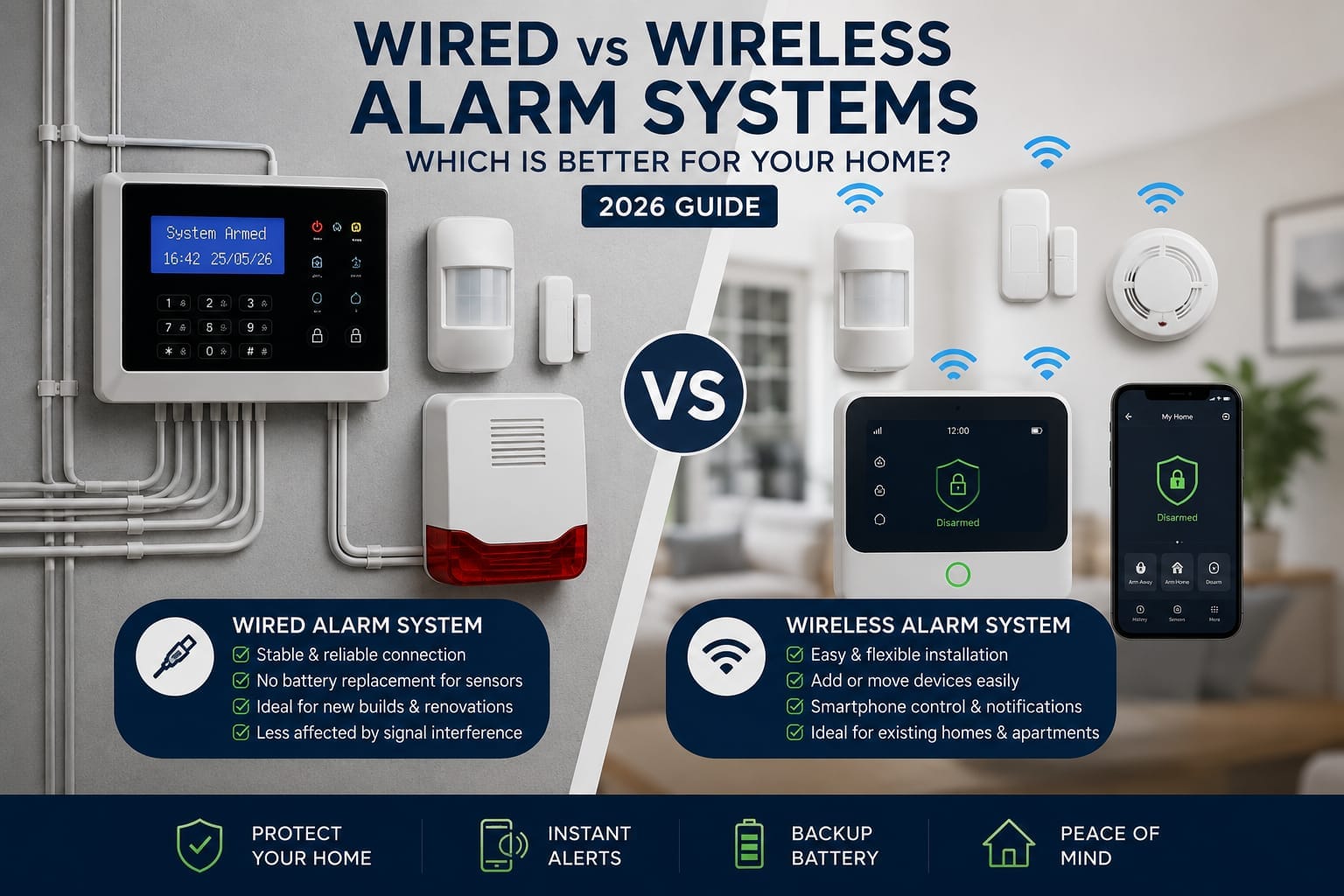

Wired vs Wireless Alarm Systems: Which Is Better for Your Home? (2026 Guide)
Choosing the right home alarm system is an important part of protecting your property. One of the first decisions homeowners need to make is whether to choose a wired or wireless alarm system.
Both systems can provide effective security, but they work differently and have different requirements for installation, maintenance, expansion and connectivity.
A wired alarm system uses physical cables to connect sensors and other devices to a central alarm panel. A wireless alarm system uses radio communication between compatible sensors and the alarm hub.
Understanding the differences between wired vs wireless alarm systems can help you choose a system that suits your home, property layout and security requirements.
What Is a Wired Alarm System?
A wired alarm system connects security devices to a central control panel using physical cabling.
Depending on the system, connected devices may include motion detectors, door and window sensors, keypads, sirens and other security equipment.
Because communication between the devices and control panel takes place through physical wiring, wired systems do not rely on wireless communication between individual sensors and the alarm panel.
Wired alarm systems are commonly considered during new construction, renovations and properties where suitable cabling already exists.
What Is a Wireless Alarm System?
A wireless alarm system uses radio frequency communication between compatible security devices and a central hub or control panel.
Wireless devices can include motion sensors, door and window contacts, sirens, keypads, remotes and other security sensors.
Many wireless sensors operate using batteries, which reduces the amount of cabling required between the sensors and control panel.
Modern wireless alarm systems may also provide smartphone applications, remote control, push notifications and integration with other compatible smart security devices.
Wired vs Wireless Alarm Systems: Key Differences
The main difference between wired and wireless alarm systems is how security devices communicate with the central alarm panel.
Wired systems use physical cables, while wireless systems communicate using radio signals.
Other important differences include installation requirements, maintenance, flexibility, battery use and the ability to expand the system later.
Installation
Wired alarm systems require cables to be installed between the alarm panel and security devices.
In an existing home, running new cables through walls, ceilings and roof spaces can make installation more involved.
For a new home or major renovation, however, wiring can often be planned before walls and ceilings are completed.
Wireless alarm systems generally require less field cabling because compatible sensors communicate wirelessly with the hub.
This can make wireless systems particularly practical for existing homes where installing new cables would be difficult or disruptive.
Advantages of Wired Alarm Systems
One of the main advantages of a wired alarm system is the stable physical connection between devices and the control panel.
Because sensors communicate through cables, they are not dependent on wireless signal strength between individual devices and the alarm panel.
Wired sensors also generally do not require individual batteries in the same way that battery-powered wireless sensors do.
This can reduce routine battery maintenance across a large alarm system.
Wired systems can be particularly suitable for:
– New homes
– Major renovations
– Larger properties
– Commercial buildings
– Properties with existing alarm cabling
– Long-term permanent installations
When cabling can be planned during construction, a wired system can provide a clean and reliable security infrastructure.
Disadvantages of Wired Alarm Systems
The biggest disadvantage of a wired alarm system is usually installation complexity.
Running cables through an existing property may require access to roof spaces, wall cavities or other areas of the building.
This can increase installation time and may make a wired system less practical in some finished homes.
Expanding a wired system later can also require additional cabling.
For this reason, it is important to consider future security requirements when planning a wired alarm installation.
Advantages of Wireless Alarm Systems
Wireless alarm systems offer greater installation flexibility.
Because sensors communicate wirelessly with the central hub, there is usually less need to run cables throughout the property.
This makes wireless systems particularly useful for existing homes, apartments and properties where new cabling would be difficult.
Another advantage is expansion.
Compatible wireless sensors can often be added later without installing new cables back to the main control panel.
Modern wireless systems may also provide convenient features such as:
– Smartphone control
– Remote arming and disarming
– Push notifications
– Door and window alerts
– Motion detection
– Wireless sirens
– Remote controls
– Smart home integration
Available features depend on the manufacturer and model.
Are Wireless Alarm Systems Suitable for My Home?
For most existing homes, wireless alarm systems can be a practical choice because they require less cabling and can be easier to expand later. They are particularly suitable for homes where running new cables would be difficult. However, the best option depends on your property layout, security requirements and whether suitable wiring already exists.
Disadvantages of Wireless Alarm Systems
Wireless systems also have some considerations.
Battery-powered sensors require battery replacement over time.
Battery life varies depending on the device, frequency of use, communication technology and environmental conditions.
Wireless communication range also needs to be considered.
Walls, building materials, distance and other sources of radio interference can affect communication between wireless devices and the alarm hub.
For larger or multi-storey properties, correct equipment selection and device placement are therefore particularly important.
Which System Is More Reliable?
Both wired and wireless alarm systems can provide reliable security when quality equipment is correctly designed, installed and maintained.
Wired systems have the advantage of physical connections between devices and the alarm panel, reducing concerns about wireless range or radio interference.
Modern professional wireless alarm systems, however, can provide supervised communication between sensors and the hub and may report issues such as low battery levels or communication faults.
The right choice depends on the property rather than simply assuming that one technology is always more reliable than the other.
Do Wireless Alarm Systems Need Wi-Fi?
Not necessarily.
The word “wireless” does not automatically mean that every sensor communicates using your home’s Wi-Fi network.
Many professional wireless alarm systems use their own radio communication technology between sensors and the alarm hub.
The hub may then use Wi-Fi, Ethernet or a cellular connection for remote smartphone access and notifications.
This means the communication between the alarm sensors and hub can be separate from the home’s normal Wi-Fi network.
The exact configuration depends on the alarm system being used.
What Happens if the Internet Goes Down?
An internet outage does not necessarily mean that the alarm itself stops detecting activity.
Depending on the system design, sensors may continue communicating with the alarm panel and the local siren may continue operating.
However, internet-dependent functions such as smartphone notifications, remote access or cloud services may become unavailable until the connection returns.
Some alarm systems can also use a cellular connection such as 4G as an alternative communication path.
When remote communication is important, the available backup communication options should be considered when selecting the system.
What Happens During a Power Outage?
Many professionally installed alarm systems include a backup battery for the main alarm panel or hub.
If mains power is interrupted, the backup battery can allow the alarm system to continue operating for a period of time.
Wireless sensors that use their own batteries are not directly affected by a household power outage.
However, internet routers and other network equipment may stop operating unless they also have backup power.
This means local alarm operation and remote internet communication should be considered separately when planning a security system.
Wired vs Wireless Alarm System Maintenance
Maintenance requirements differ between the two systems.
Wireless alarm systems require attention to sensor battery levels. Modern systems may provide low-battery warnings, but batteries still need to be replaced when required.
Wired sensors generally require less battery maintenance because they receive power through the alarm system wiring.
However, the backup battery in the main control panel should still be checked and replaced according to the manufacturer’s recommendations.
Regardless of the system type, regular testing is important to confirm that sensors, sirens and communication functions are operating correctly.
Which Is Easier to Expand?
Wireless alarm systems generally provide greater flexibility when additional sensors need to be added to an existing property.
For example, a homeowner may decide later to add another motion detector, door contact or wireless siren.
If the new device is compatible with the existing system and within communication range, installation may require little or no additional field cabling.
A wired system can also be expanded, but additional cable runs may be required.
For properties where security requirements are likely to change, future expansion should be considered before choosing the system.
What About Hybrid Alarm Systems?
The choice does not always have to be completely wired or completely wireless.
Some alarm systems support a combination of wired and wireless devices.
A hybrid system can allow existing wired sensors to continue being used while wireless devices are added in areas where installing new cables would be difficult.
This approach can be useful when upgrading an older alarm system or expanding security coverage around an existing property.
Compatibility depends on the alarm panel, receivers and devices being used.
Which Is Better for a New Home?
For a new home or major renovation, a wired alarm system deserves serious consideration.
When walls and ceilings are still open, security cabling can be planned and installed more easily.
This provides an opportunity to create permanent infrastructure for motion detectors, door contacts, keypads, sirens and other security equipment.
Wireless devices can still be incorporated where appropriate, particularly when future expansion or flexibility is required.
Planning the alarm system before construction is completed usually provides more options than waiting until the home is finished.
Which Is Better for an Existing Home?
For many existing homes, wireless alarm systems can be a practical solution.
Victoria Police also recommends alarm systems as one of the measures that can help improve home security.
Installing wireless sensors generally causes less disruption because extensive new cabling may not be required.
This can be particularly useful in finished homes where access to walls and ceilings is limited.
However, if suitable alarm cabling already exists, upgrading or reusing the wired infrastructure may also be worth considering.
The existing property should be assessed before deciding which approach is best.
Which Is Better for Apartments?
Wireless alarm systems can be particularly useful for apartments because installing new cabling through shared walls or finished building structures may be difficult.
A wireless system can provide door contacts, motion detection and other security functions without extensive building work.
However, apartment owners and tenants should also consider building rules and obtain any required permission before installing permanent equipment.
Which Is Better for Larger Homes?
Larger properties require more careful planning.
A wired system can provide predictable communication across a large property when cabling is available.
Wireless systems can also be used, but communication range, building materials and the location of the alarm hub need to be considered.
Some systems provide repeaters or other devices that can extend wireless coverage.
For large or multi-storey properties, a professional site assessment can help determine whether wired, wireless or hybrid equipment is the most appropriate choice.
Are Wireless Alarm Systems Secure?
Modern wireless security systems can use encrypted and supervised communication technologies designed specifically for security applications.
However, security capabilities vary between manufacturers and products.
When choosing a wireless alarm system, consider the quality of the equipment, communication technology, tamper protection, battery monitoring and available backup communication options.
A cheap wireless device and a professionally designed wireless security system should not automatically be treated as equivalent.
Can You Control an Alarm System From Your Phone?
Many modern wired and wireless alarm systems can support compatible smartphone applications.
Depending on the system, users may be able to:
– Arm or disarm the alarm
– Receive alarm notifications
– Check system status
– View sensor information
– Control individual areas or modes
– Manage compatible connected devices
Remote functionality generally requires an internet or cellular connection and depends on the features supported by the manufacturer.
Wired vs Wireless Alarm Systems: Which One Should You Choose?
There is no single answer that is correct for every property.
A wired alarm system may be the better option when:
– The property is being built or renovated
– Suitable cabling already exists
– A permanent installation is preferred
– The property is large
– Minimising individual sensor battery maintenance is important
A wireless alarm system may be the better option when:
– The home is already finished
– Running new cables would be difficult
– Installation flexibility is important
– The system may need to be expanded later
– Smartphone and smart security features are required
A hybrid system may provide the best solution when both wired infrastructure and wireless flexibility are useful.
Professional Alarm System Installation in Melbourne
Choosing an alarm system should start with the property and its security requirements rather than simply deciding between wired and wireless technology.
Techno Trading provides smart alarm solutions for homes and businesses across Melbourne.
We can assess the property layout, existing cabling, required sensors and communication requirements to help determine whether a wired, wireless or hybrid alarm system is suitable.
Professional installation also helps ensure that motion detectors, door and window sensors, sirens and other devices are positioned and configured correctly.
For professional installation, learn more about our Smart Alarm Installation services in Melbourne.
Conclusion
Both wired and wireless alarm systems can provide effective home security.
Wired systems offer stable physical connections and can be an excellent choice for new builds, renovations and properties with existing cabling.
Wireless systems provide greater installation flexibility and can be particularly useful for existing homes where installing new cables would be difficult.
Modern systems can also combine wired and wireless devices to create a hybrid solution.
When comparing wired vs wireless alarm systems, consider your property layout, existing cabling, future expansion, maintenance requirements, remote access needs and backup communication options.
The best alarm system is not simply the newest technology. It is the system that is properly designed for your property and how you intend to use it.
Frequently Asked Questions
Are wired alarm systems better than wireless alarm systems?
Not necessarily. Wired systems can provide stable physical connections and low sensor battery maintenance, while wireless systems offer greater installation flexibility. The better option depends on the property and security requirements.
Do wireless alarm systems work without Wi-Fi?
Many professional wireless alarm sensors communicate directly with their alarm hub using dedicated radio technology rather than the home’s Wi-Fi. However, internet access may still be required for remote smartphone features.
Will an alarm system work during a power outage?
Many alarm control panels include backup batteries that allow the system to continue operating temporarily during a mains power outage. The exact backup time depends on the equipment and battery condition.
Do wireless alarm sensors need batteries?
Many wireless sensors are battery-powered and require battery replacement over time. Battery life depends on the device, usage and manufacturer.
Can I combine wired and wireless alarm sensors?
Some alarm systems support both wired and wireless devices. These hybrid systems can be useful when existing wired sensors are combined with new wireless devices.
Which alarm system is better for an existing home?
Wireless systems can be particularly practical for existing homes because they may require less new cabling. However, if suitable wired alarm infrastructure already exists, reusing it may also be a good option.
Which alarm system is better for a new build?
A new build provides an excellent opportunity to install alarm cabling before walls and ceilings are completed. Wired or hybrid systems are therefore worth considering during the planning stage.