
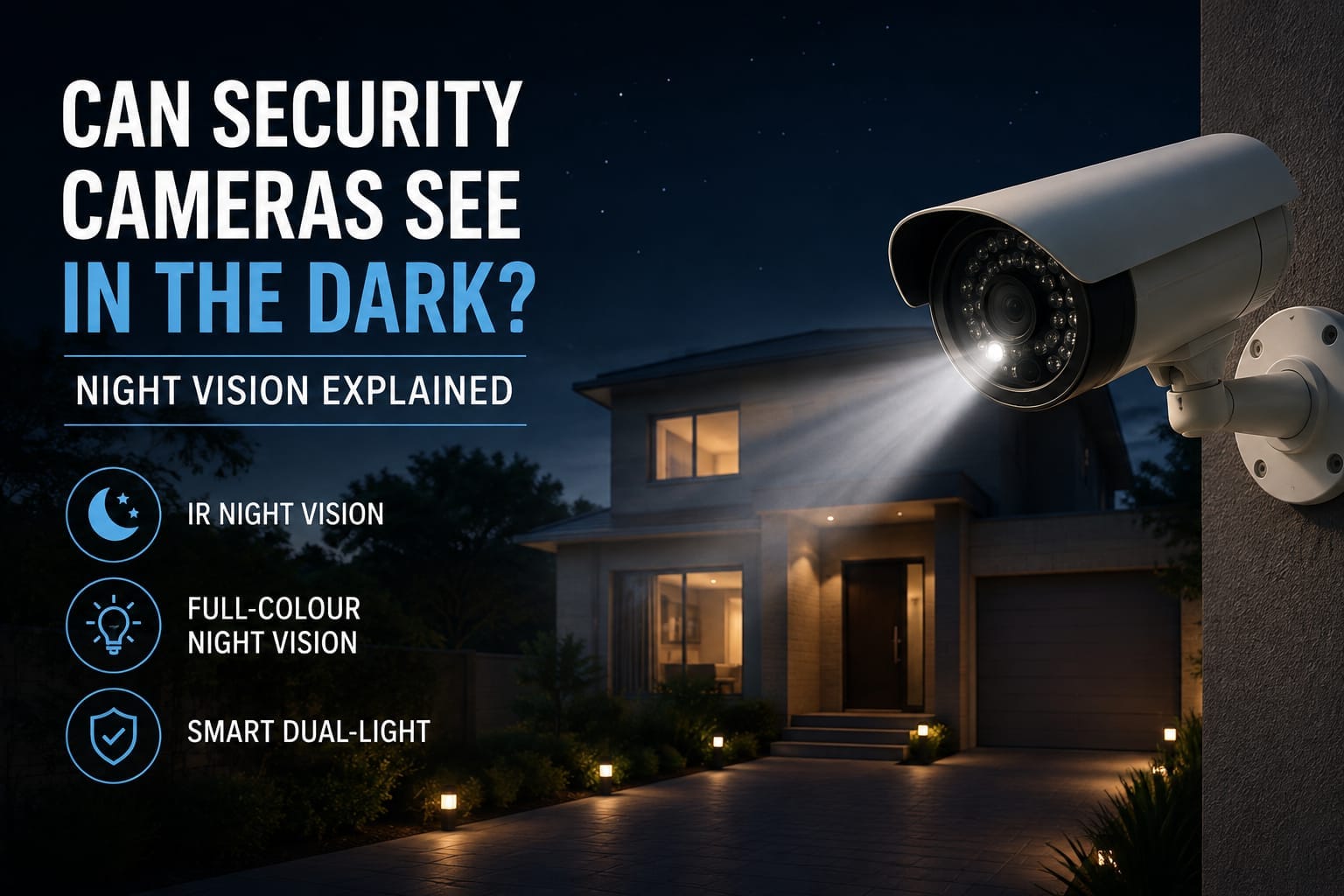
Can Security Cameras See in the Dark? Night Vision Explained (2026 Guide)
Security cameras are expected to protect a property both during the day and at night. But can security cameras actually see in the dark?
Yes, many modern security cameras can record usable footage in very low light or even complete darkness. However, the quality and colour of the image depend on the night vision technology used by the camera.
Some cameras use infrared light to produce black-and-white footage, while others use low-light sensors or built-in white lights to provide colour images at night.
Understanding these differences can help you choose suitable night vision for different areas around your home or business.
How Do Security Cameras See in the Dark?
Security cameras need some form of light to create an image. When visible light is limited, CCTV cameras can use technologies specifically designed for night time surveillance.
The most common options include:
Infrared (IR) night vision
Full-colour night vision
Low-light or starlight technology
Smart dual-light technology
Each works differently and has advantages for particular environments.
What Is Infrared Night Vision?
Infrared night vision is one of the most common technologies used in security cameras.
IR cameras contain infrared LEDs that illuminate an area with light that is generally invisible to the human eye. The camera sensor can detect this infrared light and use it to create an image.
When the surrounding area becomes dark, compatible cameras automatically switch from normal daytime mode to infrared night mode.
The resulting footage is normally black and white.
One major advantage of infrared cameras is that they can continue monitoring an area even when there is little or no visible light.
Can CCTV Cameras See in Complete Darkness?
A camera equipped with suitable infrared illumination can capture footage in complete darkness.
Instead of relying on streetlights or other visible lighting, the camera uses its own infrared LEDs to illuminate the scene.
However, night vision distance varies considerably between cameras.
The usable range depends on factors such as the strength of the IR LEDs, lens, camera sensor, installation position and surrounding environment.
A camera advertised with a particular IR range does not necessarily provide the same level of detail across that entire distance.
Why Is Infrared CCTV Footage Black and White?
Infrared CCTV footage is generally displayed in black and white because the camera is detecting infrared light rather than normal visible colours.
This can provide clear contrast and make people and objects visible in dark environments.
However, colour information is lost.
For example, you may be able to see a vehicle clearly but have difficulty determining its exact colour from infrared footage alone.
This is one reason full-colour night vision has become increasingly popular.
What Is Full-Colour Night Vision?
Full-colour night vision is designed to retain colour information after dark.
Depending on the camera, this can be achieved using a highly sensitive image sensor, a wide-aperture lens, available ambient light or a built-in white light.
Instead of switching entirely to black-and-white infrared footage, the camera attempts to maintain a colour image.
Colour can provide additional identifying information, including the colour of clothing, vehicles and other objects.
Does Full-Colour Night Vision Need Light?
Usually, some light is required to produce a colour image.
A low-light camera may use existing illumination from sources such as streetlights, garden lighting or building lights.
In darker environments, some full-colour cameras use an integrated white LED to illuminate the area.
This is an important distinction when choosing a camera.
If you do not want visible lights operating around your property at night, traditional infrared or a smart dual-light camera may be more appropriate.
What Is Smart Dual-Light Night Vision?
Smart dual-light cameras combine infrared and visible white-light technologies.
Depending on the model and configuration, the camera may normally operate using infrared illumination and then activate a white light when a person or vehicle is detected.
This can provide discreet monitoring during normal conditions while allowing colour footage to be captured during important events.
It can be particularly useful around entrances, driveways and other areas where identifying details may be important.
Infrared vs Full-Colour Night Vision
Neither technology is automatically better for every property.
Infrared night vision can be useful when you need discreet monitoring in very dark areas without continuously illuminating the area with visible light.
Full-colour night vision can be useful when colour information is important for identifying vehicles, clothing or other details.
Smart dual-light cameras provide another option by combining aspects of both technologies.
The right choice depends on the location and the type of footage you want to capture.
Why Does My Security Camera Look Blurry at Night?
A camera that produces excellent daytime footage can sometimes perform poorly at night.
Several factors can affect night time image quality.
Dirty lenses, incorrect camera positioning, reflective surfaces, insufficient illumination and excessive distance from the subject can all reduce image quality.
Strong lights pointing directly toward the camera can also create difficult exposure conditions.
Correct installation and positioning therefore remain important even when using a camera with good night vision specifications.
Can Security Cameras See Through Windows at Night?
Placing an infrared security camera behind glass can create problems at night.
Infrared light emitted by the camera may reflect from the glass back toward the lens. This can cause glare or reflections that make the image difficult to see.
Australian security-camera guidance similarly warns that IR cameras positioned behind glass can suffer from reflected infrared light.
Total Security Equipment
For outdoor monitoring, installing a suitable weather-rated camera outside the building will generally provide better nighttime results than pointing an IR camera through a window.
How Far Can Security Cameras See at Night?
There is no single night vision distance that applies to every security camera.
Different models are designed for different ranges, and manufacturers usually specify an approximate IR or illumination distance.
Actual usable image quality can also depend on:
Camera resolution and sensor
Lens and field of view
IR or white-light output
Installation height and angle
Nearby walls and reflective surfaces
Ambient lighting
Weather and environmental conditions
For this reason, advertised night vision distance should not be the only factor considered when selecting a camera.
Where Is Full-Colour Night Vision Most Useful?
Full-colour night vision can be particularly useful in locations where identifying details are important.
Common examples include:
Driveways, where vehicle colour may be useful.
Front entrances, where clothing and other identifying details may need to be captured.
Side access areas, where there may be limited natural lighting.
Commercial entrances and loading areas, where night time activity needs to be monitored.
The lighting conditions at each location should be assessed before choosing the camera technology.
Is Night Vision Important for Home Security Cameras?
Yes. Night vision performance should be considered when planning an outdoor CCTV system.
A camera should not be selected only by looking at its daytime resolution. For more guidance, read our guide on how to choose the best CCTV camera for home security.
The amount of available light after sunset, the distance that needs to be monitored and whether colour footage is required can all influence which camera is suitable.
For example, a well-lit front entrance may have different requirements from a dark side passage or backyard.
What Night Vision Is Best for Your Property?
There is no single night vision technology that is ideal for every camera position.
Infrared may be suitable for areas that remain completely dark.
Full-colour technology may be useful where colour identification is important.
Smart dual-light cameras can provide a balance between discreet infrared monitoring and colour capture when activity is detected.
In many CCTV systems, different camera technologies can be used at different locations around the same property.
Professional CCTV Installation in Melbourne
The performance of a security camera at night depends not only on the camera itself but also on its position, lighting conditions and the area being monitored.
Techno Trading provides CCTV solutions for homes and businesses across Melbourne.
We can assess camera locations, night time lighting conditions and security requirements to help select suitable cameras for different areas of your property.
For more information, visit our CCTV Installation page or contact Techno Trading to discuss your security requirements.
When installing security cameras, it is also important to consider Australian privacy and surveillance requirements.
Conclusion
So, can security cameras see in the dark?
Yes. Modern security cameras can use infrared, low-light technology or visible illumination to capture footage after dark.
Infrared cameras generally provide black-and-white images and can operate without visible lighting, while full-colour cameras are designed to retain additional colour information at night. Smart dual-light cameras can combine both approaches.
The best option depends on the amount of available light, the area being monitored and the type of detail you need the camera to capture.