
What Happens When a Home Alarm Goes Off? (2026 Guide)
A home alarm can activate in seconds, but what actually happens after a sensor detects something?
The answer depends on the type of alarm system you have and how it has been configured. Some systems simply activate a local siren, while modern smart alarms may also send notifications to your phone. Professionally monitored systems can send alarm events to a monitoring centre, where a predetermined response procedure may be followed.
Understanding what happens when a home alarm goes off can help you respond correctly and choose an alarm system that suits your property.
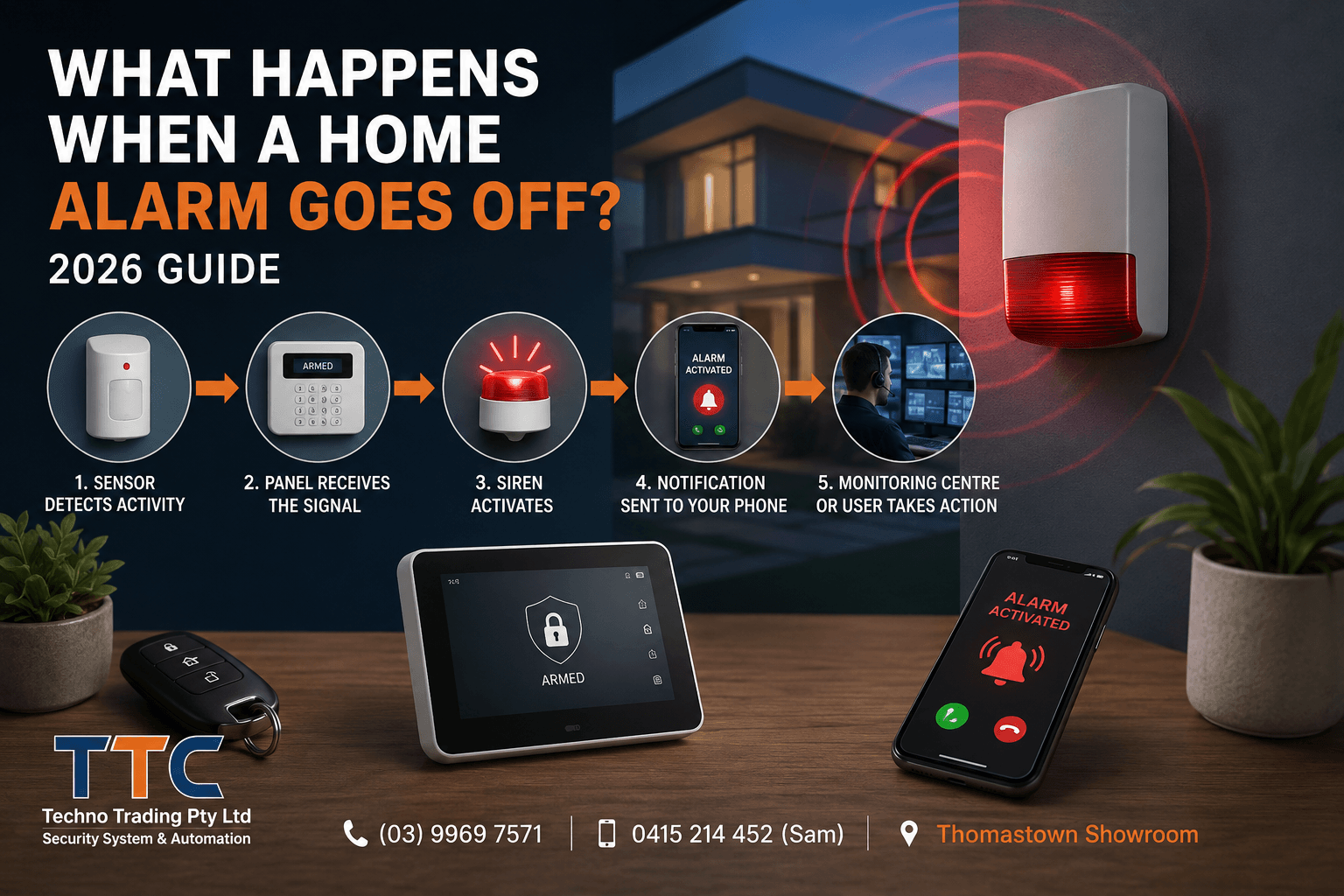
Step 1: A Sensor Detects Activity
An alarm activation normally begins when one of the security sensors detects an event.
Depending on the system, this could include:
A motion sensor detecting movement
A door or window sensor being opened
A glass-break sensor detecting broken glass
A panic or emergency button being activated
A tamper condition being detected
The sensor sends a signal to the alarm panel or smart security hub.
Step 2: The Alarm Panel Receives the Signal
The alarm panel acts as the central controller of the security system.
When it receives a signal from a sensor, it identifies which device or zone has been triggered and follows the rules programmed into the system.
For example, an entry door may have a short entry delay to allow an authorised user to disarm the system.
Other protected areas may be configured to trigger the alarm immediately.
Step 3: The Siren Activates
If the alarm condition is confirmed according to the system configuration, an internal or external siren may activate.
The loud sound has two main purposes: alerting people in or around the property and helping deter an intruder.
Some alarm systems also include an external flashing strobe, which can make it easier to identify the property where the alarm has been activated.
The exact behaviour and duration of the siren depend on the alarm equipment and configuration.
Step 4: A Mobile Notification May Be Sent
Many modern smart alarm systems can send an alert to a compatible smartphone application.
The notification may tell you that the alarm has activated and, depending on the system, identify which sensor or zone caused the event.
For example, you might receive a notification indicating that a front-door sensor or living-room motion detector has been triggered.
This can be particularly useful when you are away from home.
Step 5: You Check What Triggered the Alarm
If your alarm provides remote information, the next step is to determine what may have caused the activation.
Some users combine their alarm system with CCTV cameras, allowing them to check live or recorded footage separately after receiving an alarm notification.
This can help distinguish between a possible security incident and an accidental activation.
However, you should not put yourself at risk by entering a property if you genuinely suspect an intruder may be present.
Local Alarm vs Self-Monitored Alarm
Not every alarm system responds in the same way.
A local alarm may primarily activate a siren and strobe at the property. It relies on occupants, neighbours or other people nearby noticing the alarm.
A self-monitored alarm can additionally send notifications to the owner’s smartphone when supported and correctly configured.
With self-monitoring, the homeowner is responsible for checking the alert and deciding what action is appropriate.
This provides flexibility but also means the response depends on someone seeing the notification.
What Happens With a Professionally Monitored Alarm?
A professionally monitored alarm operates differently.
When an eligible alarm event is received by the monitoring service, trained operators can follow the response instructions associated with the account.
Depending on the service, alarm type and response plan, this may involve contacting nominated people, a keyholder or arranging another appropriate response.
Professional monitoring does not mean that every alarm activation automatically results in police attending the property.
In Victoria, police alarm response follows specific procedures. Victoria Police distinguishes different categories of alarm events, and monitoring companies seeking police assistance for Category A alarms must meet particular requirements.
Does the Police Automatically Come When a Home Alarm Goes Off?
No.
This is an important misconception.
A standard home alarm sounding does not automatically mean Victoria Police will be dispatched.
The response depends on factors including the type of alarm, whether professional monitoring is used, available verification and the circumstances of the event.
Victoria Police has specific alarm-response procedures for security monitoring companies.
If there is an actual emergency requiring immediate police, fire or ambulance assistance, Victoria Police directs people to call Triple Zero (000).
What Happens if Your Alarm Goes Off While You’re Away?
This is where remote notifications can be particularly useful.
If your alarm is connected to a compatible app, you may receive an alert even when you are away from the property.
Depending on your equipment, you may be able to see which zone triggered, check the status of the system and review available security-camera footage.
If you have professional monitoring, the monitoring provider follows the response plan associated with your service.
The important point is to decide how alarm events will be handled before an incident occurs.
What Happens if the Internet Is Down?
An internet outage does not necessarily stop the local alarm system from detecting activity.
Many alarm sensors communicate directly with the alarm panel or hub rather than depending on the home’s internet connection for basic detection.
The siren may therefore continue to operate locally.
However, internet-dependent functions such as app notifications, cloud services and remote control may be unavailable until connectivity returns.
Some security systems provide alternative communication methods such as cellular connectivity, depending on the equipment and service being used.
What About 4G/GSM Alarm Systems?
Some alarm systems can use a SIM card and mobile network connection as their primary or backup communication method.
This can provide another communication path when fixed internet is unavailable.
Depending on the system and configuration, cellular connectivity may be used for notifications, remote communication or monitoring.
However, cellular operation depends on mobile network coverage, compatible equipment and an active service or SIM arrangement where required.
What Happens During a Power Outage?
Many alarm control panels and hubs include backup batteries.
If mains electricity fails, the backup battery may allow the alarm to continue operating for a period of time.
Battery-powered wireless sensors are also not directly dependent on household mains power.
However, other equipment such as your internet router may stop operating unless it also has backup power.
For this reason, local alarm operation and internet-based communication should be considered separately.
What Is a False Alarm?
A false alarm occurs when a security system activates even though there is no genuine security incident.
Common causes can include incorrect arming or disarming, unsuitable sensor placement, pets triggering non-pet-compatible motion detectors, doors or windows not being properly secured, equipment problems or incorrect system configuration.
Repeated false alarms should not simply be ignored.
The cause should be identified and corrected so that users can trust the system when a genuine alarm occurs.
How Can False Alarms Be Reduced?
Correct installation and configuration are important.
Motion detectors should be positioned appropriately for the property, and suitable sensor types should be selected for each area.
Users should also understand entry and exit delays and know how to arm and disarm the system correctly.
Sensor batteries should be replaced when required, and equipment faults should be investigated rather than ignored.
If pets live inside the property, compatible sensor options and correct placement should be considered.
What Should You Do When You Receive an Alarm Notification?
First, check the information provided by the alarm system.
Identify which sensor or zone triggered and, if you have cameras available, review the footage from a safe location.
If the activation is clearly accidental, follow the appropriate procedure for your alarm or monitoring service.
If you believe there may be an intruder at the property, do not unnecessarily put yourself in danger by entering the building.
For an emergency requiring immediate police, fire or ambulance assistance in Victoria, call Triple Zero (000).
Why Alarm Configuration Matters
Buying good alarm equipment is only part of creating an effective security system.
The system also needs to be configured around the property and how the occupants use it.
Important considerations include:
Sensor locations
Entry and exit delays
Siren configuration
Home and Away modes
Mobile notifications
User access
Backup power
Internet or cellular communication
False-alarm prevention
A correctly configured system should provide useful alerts without creating unnecessary activations.
Professional Smart Alarm Installation in Melbourne
Techno Trading provides smart alarm solutions for homes and businesses across Melbourne.
A security alarm can include compatible motion detectors, door and window sensors, sirens, remotes, mobile notifications and other security devices depending on the selected system.
The appropriate configuration depends on the property’s layout and the level of security required.
Professional planning and installation can help ensure sensors are positioned correctly and that alarm notifications, sirens and other functions operate as intended.
Conclusion
So, what happens when a home alarm goes off?
First, a sensor detects an event and sends information to the alarm panel. The system then follows its programmed response, which may include activating a siren, flashing a strobe, recording the event and sending a mobile notification.
If professional monitoring is used, the alarm event may also be handled according to the monitoring service’s response procedures.
The exact response depends on the equipment and configuration, which is why understanding how your alarm works is just as important as installing one.
Frequently Asked Questions
Will my phone receive a notification when my alarm goes off?
If your alarm system supports app notifications and the feature is correctly configured, it may send an alert to your smartphone when an alarm event occurs.
Will police automatically come if my alarm goes off?
No. Police attendance is not automatic simply because a home alarm sounds. In Victoria, monitored alarm responses are subject to specific procedures and circumstances.
Can my alarm work without internet?
Many systems can continue providing basic local detection and siren functions without internet access, although remote app functions may be affected.
Can an alarm work during a power outage?
Systems equipped with a suitable backup battery may continue operating temporarily during a mains power outage.
What causes false alarms?
Possible causes include user error, unsuitable sensor positioning, pets, unsecured doors or windows, low batteries and equipment or configuration issues.
What should I do if I think someone has broken into my home?
Avoid entering the property if doing so could put you at risk. If there is an immediate emergency requiring police assistance in Victoria, call Triple Zero (000).